
Gravity and Cosmology Group
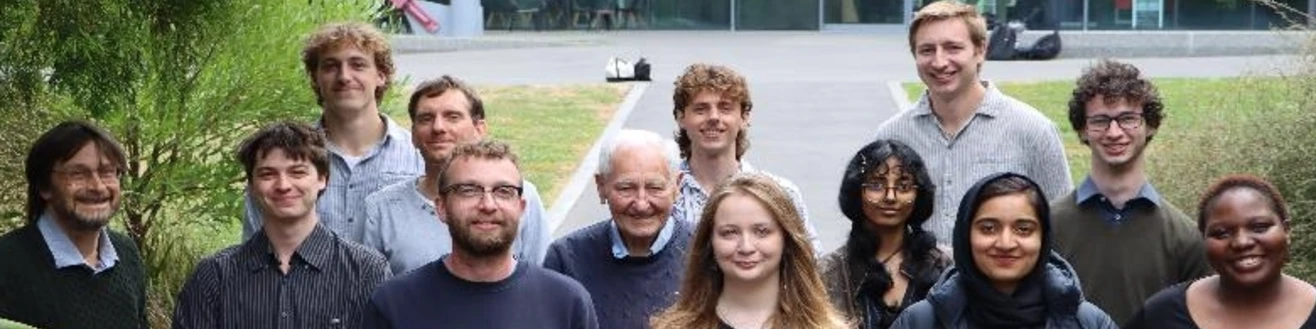
PEOPLE
- Senior Lecturer
- Mathematics and Statistics
- Senior LecturerMathematics and Statistics
I am a mathematical and numerical relativist specialising in global properties of space-times and solving Einstein's equations on the computer in a variety of different contexts.
Mathematical general relativity ties fundamental problems of gravitational physics with beautiful questions in mathematics. The object is the study of manifolds equipped with a Lorentzian metric satisfying the Einstein field equations. Due to the broad scope of questions one can ask about the physics, many different areas of mathematics are employed such as group theory, topology, differential geometry and partial differential equations.
Numerical relativity is used to obtain approximations to the complicated systems produced by the Einstein equations. In general these systems will have no closed form solutions and thus numerical methods must be employed. Differential geometry, PDE theory and numerical methods work together to simulate complicated space-times such as binary black hole or neutron star mergers. High performance computing facilities are utilised and hundreds if not thousands of CPU cores are required to complete simulations in reasonable time frames.
I co-lead the Gravity and Cosmology Research Group with Prof. David Wiltshire: https://www.canterbury.ac.nz/research/about-uc-research/research-groups-and-centres/gravity-and-cosmology-group
I am a researcher in the Hyperboloidal Research Network: https://hyperboloid.al/people/
I am also interested in applying mathematics, algorithm development and scientific programming to real world problems.I am a mathematical and numerical relativist specialising in global properties of space-times and solving Einstein's equations on the computer in a variety of different contexts.
Mathematical general relativity ties fundamental problems of gravitational physics with beautiful questions in mathematics. The object is the study of manifolds equipped with a Lorentzian metric satisfying the Einstein field equations. Due to the broad scope of questions one can ask about the physics, many different areas of mathematics are employed such as group theory, topology, differential geometry and partial differential equations.
Numerical relativity is used to obtain approximations to the complicated systems produced by the Einstein equations. In general these systems will have no closed form solutions and thus numerical methods must be employed. Differential geometry, PDE theory and numerical methods work together to simulate complicated space-times such as binary black hole or neutron star mergers. High performance computing facilities are utilised and hundreds if not thousands of CPU cores are required to complete simulations in reasonable time frames.
I co-lead the Gravity and Cosmology Research Group with Prof. David Wiltshire: https://www.canterbury.ac.nz/research/about-uc-research/research-groups-and-centres/gravity-and-cosmology-group
I am a researcher in the Hyperboloidal Research Network: https://hyperboloid.al/people/
I am also interested in applying mathematics, algorithm development and scientific programming to real world problems.- Faculty of Engineering
- Registered to supervise Master's/Doctoral students
- Collaborative research projects
- Media enquiries
- Outreach & community engagement
Fields of Research- General relativity and gravitational waves
- Partial differential equations
- Numerical computation and mathematical software
- Algebraic and differential geometry
- Professor
- School of Physical & Chemical Sciences
- ProfessorSchool of Physical & Chemical Sciences
My interests broadly cover general relativity, quantum gravity and cosmology. Early in my career my main contributions were on gravitational aspects of higher-dimensional unified models, including so-called brane worlds, in which I was a pioneer. I have made many contributions on higher-dimensional black holes, and have also worked in quantum cosmology. More recently, I have become interested in the challenges to theoretical cosmology posed by new observations, in particular by cosmic acceleration and “dark energy”. I have revisited old assumptions concerning the operational interpretation of measurements in cosmology, and the way we average a universe, which is in fact very lumpy, with galaxy clusters strung in filaments and sheets around huge voids. “Dark energy” may in fact be a misidentification of “quasi-local gravitational energy”, an aspect of Einstein’s theory that we have yet to fully understand. I have proposed a viable alternative to the standard model - the timescape cosmology. My team and I are testing its properties. In future we aim to more deeply understand the nature of gravitational energy by rigorously construct a modified statistical geometry for the universe. The aim is to understand "dark energy" and possibly also "dark matter" as a modified geometrical theory of gravity rather than new exotic "stuff".My interests broadly cover general relativity, quantum gravity and cosmology. Early in my career my main contributions were on gravitational aspects of higher-dimensional unified models, including so-called brane worlds, in which I was a pioneer. I have made many contributions on higher-dimensional black holes, and have also worked in quantum cosmology. More recently, I have become interested in the challenges to theoretical cosmology posed by new observations, in particular by cosmic acceleration and “dark energy”. I have revisited old assumptions concerning the operational interpretation of measurements in cosmology, and the way we average a universe, which is in fact very lumpy, with galaxy clusters strung in filaments and sheets around huge voids. “Dark energy” may in fact be a misidentification of “quasi-local gravitational energy”, an aspect of Einstein’s theory that we have yet to fully understand. I have proposed a viable alternative to the standard model - the timescape cosmology. My team and I are testing its properties. In future we aim to more deeply understand the nature of gravitational energy by rigorously construct a modified statistical geometry for the universe. The aim is to understand "dark energy" and possibly also "dark matter" as a modified geometrical theory of gravity rather than new exotic "stuff".- Faculty of Science
- Registered to supervise Master's/Doctoral students
- Media enquiries
- Outreach & community engagement
Fields of Research- General relativity and gravitational waves
- Cosmology and extragalactic astronomy
- Mathematical aspects of general relativity